


Blog
Milestone Inventions That Shaped Modern Timekeeping

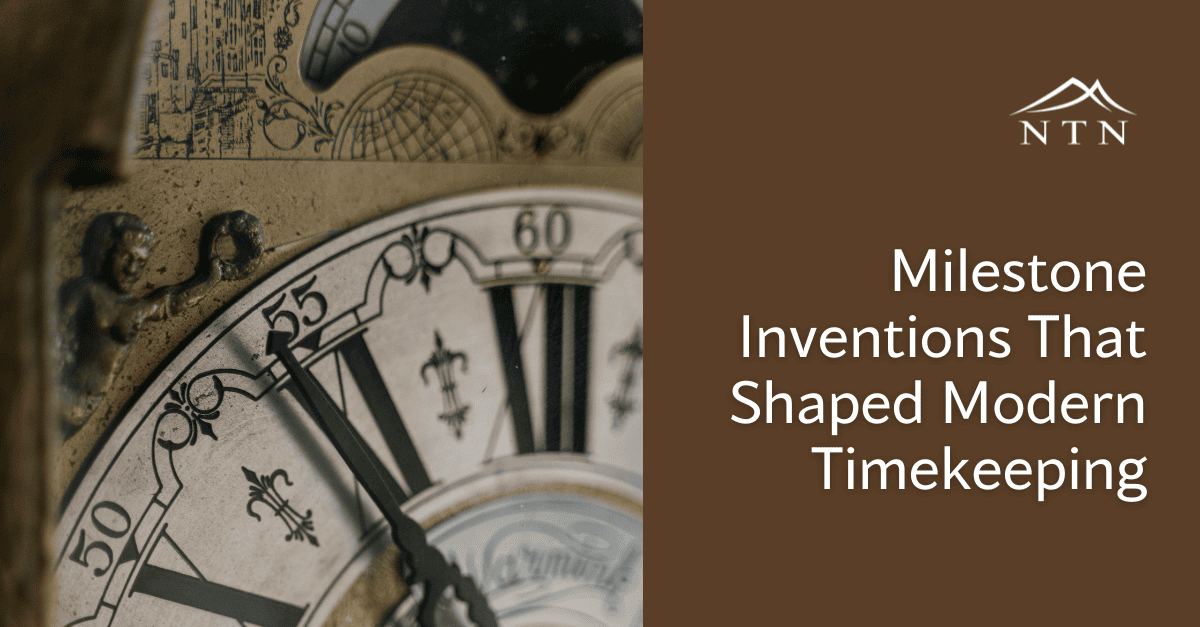
Timekeeping has always been more than a practical necessity—it’s a reflection of human progress. From ancient civilizations observing the movement of the sun to today’s ultra-precise atomic clocks, the quest to measure time has shaped science, engineering, and daily life itself.
The evolution of timekeeping is marked by discoveries that transformed how we live, work, and connect. Let’s explore the milestone inventions that shaped modern timekeeping, tracing the path from early observation to the precision technologies we wear on our wrists today.
The Dawn of Time Measurement
Long before mechanical devices, humans measured time using nature itself. The earliest “clocks” were the sky—the sun, moon, and stars. Ancient civilizations developed systems to divide days and nights into measurable segments.
The sundial, one of the first true instruments for tracking time, appeared around 1500 BCE in Egypt. Using shadows cast by the sun, it gave people a reliable way to mark hours during daylight. However, sundials failed after sunset, prompting the invention of new methods to measure passing hours.
Water and Sand: Early Mechanical Concepts
The next major leap came with water clocks (clepsydrae) and sand timers. These devices didn’t rely on sunlight and could measure time consistently, even at night.
Water clocks worked by allowing water to drip at a steady rate from one container to another, while sand timers used gravity to move fine grains through a narrow neck. Both represented early understandings of controlled flow—a concept that would become central to later mechanical clocks.
Though primitive compared to modern standards, these inventions introduced the idea of regulated timekeeping—a foundation on which all future innovations were built.
The Birth of the Mechanical Clock
The true transformation of timekeeping began in the 14th century, when mechanical clocks appeared in European monasteries. These early clocks used weights, gears, and escapements to regulate motion, allowing for continuous, measurable time.
The verge escapement mechanism was particularly revolutionary. It controlled the release of energy from the clock’s weight-driven system, creating a consistent ticking rhythm. For the first time, humans could track hours with remarkable accuracy, independent of natural cycles.
Public clock towers soon followed, symbolizing both civic pride and technological mastery. These machines not only governed religious observances but also synchronized communities—a precursor to modern coordinated time.
The Mainspring and the Birth of Portability
In the 15th century, another milestone changed everything: the mainspring.
This coiled metal spring replaced heavy weights, making clocks smaller and portable. Clockmakers could now design timepieces compact enough to be carried, leading to the first pocket watches in the 16th century.
These early watches were handmade works of art, often inaccurate by today’s standards. Still, the concept of personal timekeeping had begun—a turning point that brought the measurement of time from towers to individuals.
The Balance Spring and Precision Timekeeping
The next great leap came in 1675, when Dutch scientist Christiaan Huygens introduced the balance spring (or hairspring).
This thin, coiled spring worked with the balance wheel to regulate oscillations, dramatically improving accuracy. Watches could now measure time to within minutes per day, rather than hours.
The invention of the balance spring marked the beginning of modern horology—the science of precise time measurement. It also paved the way for innovations like the minute hand, which soon became standard.
The Chronometer and Maritime Navigation
By the 18th century, accurate timekeeping had become essential for global exploration. Sailors needed precise time to calculate longitude and navigate safely across oceans.
This challenge led to one of the most important inventions in history: the marine chronometer.
Developed by John Harrison in the mid-1700s, the chronometer could maintain accuracy despite the motion, temperature, and humidity of sea travel. It allowed navigators to determine their position with unprecedented precision, changing maritime history forever.
The chronometer’s success proved that accuracy could be engineered, inspiring generations of watchmakers to pursue ever-finer precision.
The Industrial Revolution and Mass Production
The Industrial Age of the 19th century brought machinery, factories, and a new relationship with time. Punctuality became a virtue, and watches became tools of the modern worker.
Advancements in manufacturing made watches more affordable and standardized. Factories introduced interchangeable parts, replacing bespoke craftsmanship with efficient production methods.
This democratization of timekeeping transformed society. Workers could synchronize schedules, trains could run on time, and industries could coordinate across vast distances.
Watches evolved from luxury items into everyday necessities—a defining symbol of the industrial world.
The Railroad Watch and Standardized Time
The expansion of railroads in the 19th century created a new demand for absolute precision. Slight timing errors could cause catastrophic collisions.
This led to the development of railroad-grade watches, built to strict accuracy standards. These watches were tested for consistency, shock resistance, and temperature stability.
The need for synchronization also gave rise to standardized time zones—a global system still used today. Without these innovations, coordinated travel and commerce would have been impossible.
The 20th Century: The Quartz Revolution
Few inventions reshaped modern timekeeping as profoundly as quartz technology.
In 1927, engineers discovered that quartz crystals vibrate at a constant frequency when exposed to electricity. This property allowed quartz watches to measure time with incredible accuracy—far surpassing mechanical movements.
By the 1970s, quartz watches had become widespread, offering precision within seconds per month. They required no winding, minimal maintenance, and were far more affordable than their mechanical counterparts.
This “Quartz Revolution” made reliable timekeeping accessible to everyone, cementing quartz as the foundation of modern watch technology.
The Atomic Clock: Defining Absolute Time
If quartz watches brought precision to the wrist, atomic clocks defined time itself.
First developed in 1949, atomic clocks measure vibrations of atoms—usually cesium or rubidium—with astonishing accuracy. The deviation is less than one second in millions of years.
Today, atomic clocks are used to regulate global systems like GPS, telecommunications, and scientific research. They serve as the international standard for measuring time, ensuring synchronization across the world.
Every digital device we use—from smartphones to satellites—relies on this invisible network of atomic precision.
The Digital and Smartwatch Era
The late 20th and early 21st centuries saw digital technology merge with traditional watchmaking. LED and LCD displays introduced new ways to visualize time, while microprocessors enabled multifunctional designs.
The arrival of smartwatches took timekeeping into the digital age. Modern smartwatches do far more than tell time—they track health, display notifications, and connect seamlessly with smartphones.
Yet, even as watches became technological companions, they retained their symbolic value. The craftsmanship and heritage of traditional timepieces continue to inspire modern design.
How These Inventions Transformed Daily Life
Each milestone invention did more than improve accuracy—it reshaped culture.
The sundial taught early societies to structure their days. The mechanical clock synchronized communities. The quartz revolution democratized precision. And the smartwatch connected time to information and wellness.
Together, these innovations turned timekeeping into an integral part of daily human experience—linking history, technology, and lifestyle.
A Quick Look at Timekeeping’s Transformational Timeline
| Era | Key Invention | Impact on Timekeeping |
| Ancient Civilizations | Sundial and Water Clock | Introduced measurable hours |
| 14th–17th Century | Mechanical Clock & Balance Spring | Enabled precise, portable timepieces |
| 18th Century | Marine Chronometer | Revolutionized navigation and accuracy |
| 19th Century | Industrial Manufacturing | Made watches accessible to the masses |
| 20th Century | Quartz Movement | Redefined precision and affordability |
| 21st Century | Smartwatch | Integrated technology and lifestyle |
The Enduring Legacy of Timekeeping Innovation
The journey of timekeeping is far from over. Even as technology advances, the principles established centuries ago—precision, reliability, and craftsmanship—remain at its core.
Modern innovations like atomic synchronization, solar charging, and hybrid smartwatches continue to build on these early breakthroughs.
Every watch—mechanical, quartz, or digital—is part of this shared legacy. It’s a reminder that measuring time is not just about seconds and hours—it’s about human progress.If you’re drawn to watches that blend design and innovation, NTN’s official collection of watches offers timeless craftsmanship and modern precision.


