


Blog
The Evolution of Chronographs and Their Role in Aviation

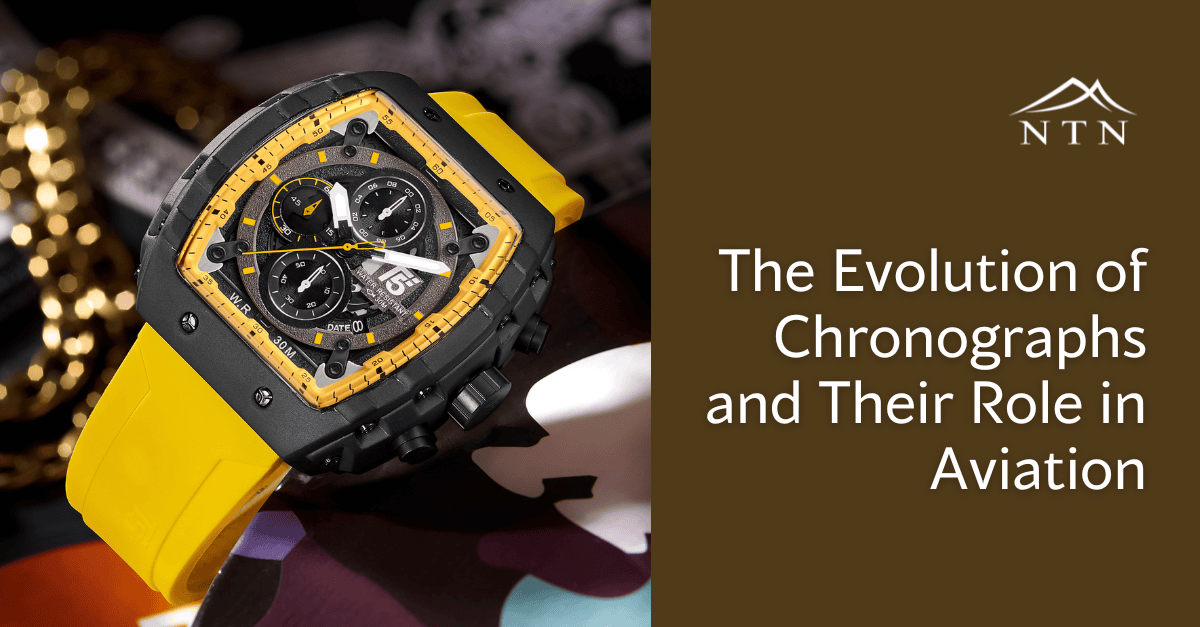
Few inventions in horology have influenced human achievement as profoundly as the chronograph. More than a stopwatch, it became a precision instrument that helped aviators navigate, calculate, and conquer the skies.
From 19th-century laboratories to modern cockpits, the chronograph’s story mirrors the evolution of flight itself—driven by innovation, accuracy, and the human desire to measure time in motion.
The Origins of the Chronograph
The term chronograph comes from the Greek words chronos (time) and graphein (to write). The earliest versions weren’t wristwatches at all but scientific devices that literally “wrote” time.
In 1816, French watchmaker Louis Moinet created the first known chronograph to measure astronomical events. His device could record intervals to 1/60th of a second—unheard of precision for the time.
A few years later, Nicolas Mathieu Rieussec developed a chronograph for timing horse races. His model used ink to mark elapsed time on a rotating dial, introducing the concept of visual time recording.
Although these early instruments were bulky and complex, they laid the foundation for one of the most practical complications in modern watchmaking.
From Pocket to Wrist: Miniaturization and Function
By the late 19th century, chronographs had become smaller and more reliable. Pocket chronographs gained popularity among engineers, scientists, and sportsmen.
The transition from pocket to wrist accelerated during World War I, when soldiers and pilots needed quick access to time without fumbling for a pocket watch. Strapping a watch to the wrist was not yet fashionable—it was functional.
This necessity gave birth to the wrist chronograph, a rugged, legible, and precise companion that would soon find its destiny in aviation.
The Chronograph Takes Flight
Early aviators faced immense challenges. Without advanced instruments or autopilot systems, they relied on simple tools—maps, compasses, and watches—to navigate.
A chronograph allowed them to measure flight duration, calculate speed, and estimate distance traveled. It became an essential part of early cockpit navigation, especially before radio communication and GPS.
Pilots could use the chronograph’s stopwatch function to time maneuvers, synchronize with other aircraft, or track fuel consumption. In an era when precision meant survival, a reliable chronograph could make the difference between reaching a destination and losing one’s way in the clouds.
World War II: The Chronograph as a Flight Instrument
The Second World War marked a defining chapter in the chronograph’s evolution. As aviation technology advanced, so did the instruments pilots depended on.
Military-issue chronographs were designed for clarity, durability, and functionality. Large luminous numerals ensured legibility under low light, while oversized crowns and pushers allowed pilots to operate their watches while wearing gloves.
Some models introduced flyback mechanisms, enabling the wearer to reset and restart the timer instantly—a vital feature for timing successive maneuvers or flight legs.
For pilots, the chronograph became more than a watch. It was a cockpit tool, a lifeline, and a trusted partner in the air.
The Jet Age and the Rise of the Professional Pilot Watch
After the war, aviation entered the jet age, and the chronograph evolved alongside it.
As commercial and military aviation expanded, pilots needed watches that could keep up with faster speeds and longer flights. Chronographs began incorporating tachymeter scales to measure speed and slide-rule bezels for complex calculations like fuel consumption and flight distance.
These innovations turned the chronograph into both a professional instrument and a symbol of technical mastery. Even as radar and onboard computers emerged, pilots continued to wear chronographs—partly for function, partly for tradition.
The Quartz Revolution and the Challenge of Change
The 1970s Quartz Revolution brought a seismic shift to the watch industry. Battery-powered quartz watches were cheaper, more accurate, and easier to maintain than their mechanical counterparts.
Chronographs were not immune to this disruption. Digital quartz chronographs offered split-second precision and multiple timing modes in a compact format. Mechanical chronographs seemed destined to become obsolete.
But something unexpected happened. Rather than disappear, mechanical chronographs adapted. Collectors, aviation enthusiasts, and professionals began to value them not just for function but for what they represented—craftsmanship, heritage, and the art of mechanical engineering.
The chronograph survived because it offered something quartz never could: a tangible, emotional connection to time.
Mechanical Craftsmanship and Cultural Legacy
Every mechanical chronograph tells a story of precision and patience. Inside its case are hundreds of meticulously assembled parts—gears, springs, and levers working in harmony to record time.
Unlike a digital display, a mechanical chronograph engages the senses. You can feel the smooth resistance when pressing the pusher, hear the faint click of engagement, and watch the hands sweep with purpose.
In a cockpit or on a wrist, that tactile experience carries weight. It represents the continuity of craftsmanship in an era dominated by digital automation.
If you value the blend of timeless design with modern craftsmanship, explore NTN’s official collection.
The Chronograph in Modern Aviation
Today’s pilots rely on advanced avionics, GPS, and digital instruments. Yet, many still wear chronographs—not out of necessity, but respect.
A mechanical chronograph serves as a redundant analog backup—reliable even when electronics fail. More importantly, it symbolizes a lineage that stretches back to the dawn of flight.
Modern aviation chronographs often include features like multiple time zones, anti-magnetic protection, and chronometer certification, blending precision with practicality. Whether worn in a cockpit or on the ground, they remain enduring symbols of human ingenuity.
Innovation Beyond the Sky
The chronograph’s legacy extends far beyond aviation. Its precision has made it indispensable in motorsport, diving, and space exploration. Yet, its association with flight remains the most iconic.
The instrument that once helped pilots navigate the skies continues to inspire designers and engineers. Modern chronographs are lighter, more accurate, and more durable than ever—proof that progress doesn’t replace tradition; it refines it.
Why Chronographs Still Captivate Enthusiasts
Despite digital technology’s dominance, the chronograph remains one of the most popular and respected watch complications. Its appeal lies in a combination of heritage, mechanical beauty, and versatility.
For collectors and aviators alike, a chronograph watch isn’t just a device—it’s an heirloom. It reflects a passion for precision and a respect for the craftsmanship that made human flight possible.
Chronographs bridge two worlds: the mechanical past and the digital present. They remind us that while technology evolves, the human desire to measure, understand, and master time never fades.
Final Thoughts: A Timeless Companion in Flight
The evolution of chronographs and their role in aviation is a story of innovation meeting purpose. From the first stopwatches used by scientists to the mechanical marvels worn by pilots, the chronograph has always embodied one idea—time in motion.
It survived wars, revolutions, and technological upheaval because it represents something more than function: it represents endurance.
For those who appreciate that blend of precision and heritage, a chronograph is not just a timekeeper—it’s a testament to humanity’s pursuit of mastery in both craft and flight.


